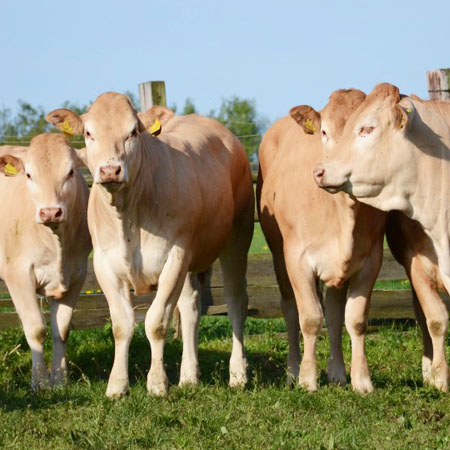
The Blonde d'Aquitaine breed was not officially recognized until 1962. In the Czech Republic, breeding of this breed dates back to 1991. It originates from southwestern France.
Three local regional cattle breeds contributed to its development: the Quercy, the Garonnaise, and the Blonde des Pyrénées, which were used primarily for draft work but also
for meat production. Today, the breed is focused almost exclusively on the production of high-quality meat. It is a breed with high growth potential and excellent slaughter value.
We started breeding Blonde d'Aquitaine cattle in 2008. It is a very young breed and not very common in the Czech Republic.
We operate a closed herd. With the exception of the breeding bulls, all animals are bred on our farm. Each year, we inseminate approximately one-third of the cows with the best
bulls in the world; the remaining herd is managed by two breeding bulls. The number of cows ranges up to 50.
Blonde d'Aquitaine cattle are large-framed animals with exceptional body length, a fine bone structure, and exceptionally well-developed musculature. Their excellent meat production
and low fat content make this breed highly desirable. Due to their larger frame, the animals are not bred until a later age (we start at 24 months), which is more financially demanding.
This breed is not for everyone and is a challenge in many respects. Because of the breed’s large frame, it has high nutritional requirements. In breeding, every mistake is reflected
in the difficulty of calving and the viability of the calves. The breeder must pay close attention to detail. Then the animals of this breed will reward him. We even have 17-year-old cows.
Our success or failure depends on whether we can raise strong and resilient calves.
We wanted to share the quality of our animals with other breeders, so we joined a performance testing program. Each of our animals is weighed and evaluated. Their pedigree must be
verified by genetic analysis. They must not have any conformation or temperament defects. Bulls must be able to be presented on a halter or with a nose ring. If they meet all these criteria, they can
be included in the breeding program. In our case, they can also strengthen organic herds.